
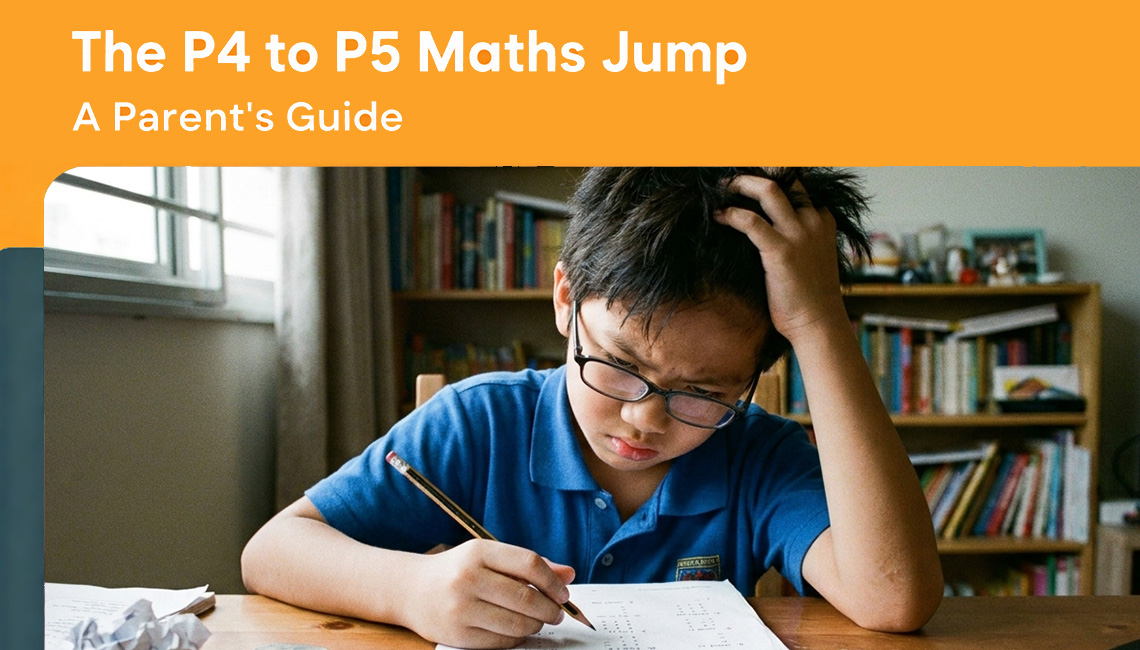
Many parents are caught off guard when a child who performed well in P4 suddenly finds Maths difficult at P5. The grades dip, the homework takes longer, and the confidence takes a knock. It can feel as though something has gone wrong.
In most cases, nothing has gone wrong. The P4 to P5 transition is widely regarded as the steepest difficulty jump in Singapore primary school Maths, and it catches a far larger number of children than parents realise.
Understanding what changes, and why it feels so sudden, is the first step to helping your child navigate it.
What Changes in P5 Maths
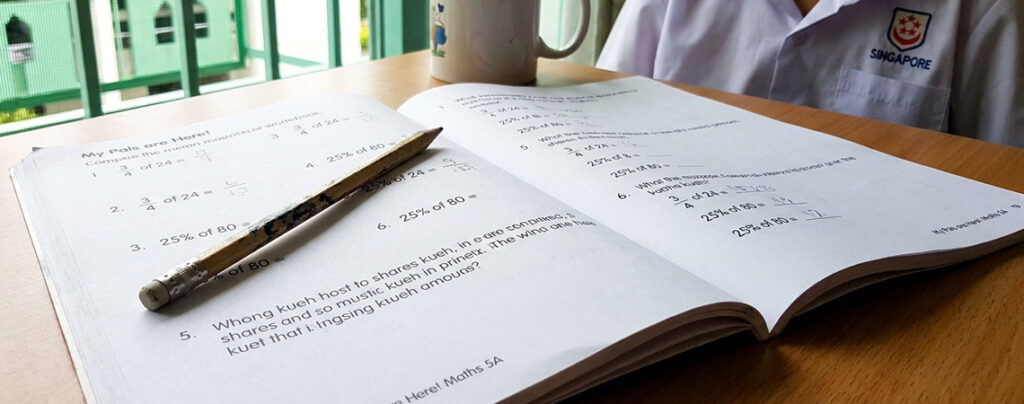
Primary 4 Maths focuses on consolidating foundational skills: whole numbers, basic fractions, basic geometry, and simple word problems. The content is demanding but largely concrete. Children learn procedures and apply them in relatively predictable ways.
Primary 5 introduces a significant shift. According to the MOE Primary Mathematics Syllabus, new topic categories appear at this level, including rate and more complex percentage problems. Fractions become harder, with multiplication and division of mixed numbers now in scope. Geometry questions grow more multi-layered.
More importantly, P5 requires children to choose the right method from several options, rather than apply a known procedure. This cognitive shift is the part that is rarely made explicit to students, and it is where most of them stumble.
Why the Jump Feels So Sudden

In P4, most problems have a clear method attached to them. Students learn a technique and practise it. The connection between question type and solution is fairly direct.
In P5, that connection becomes less obvious. A question may involve fractions, but it requires ratio thinking to unlock. A geometry problem may demand percentage reasoning at its core. Students who are used to pattern-matching their way through maths problems suddenly find that approach no longer reliable.
This is not a sign that a child is weak at Maths. It is a sign that they have reached the level where genuine mathematical thinking is required. The students who adapt fastest are often those who have been encouraged to understand why methods work, not just how to apply them.
One pattern that comes up often in the classroom is a student who scored well in P4 simply giving up partway through a P5 question, even one they are capable of solving. On closer observation, the issue is rarely a lack of ability. It is usually that the child has not been taught to recognise which method a question is calling for, since that skill was never needed at P4. Once this is pointed out and practised deliberately, confidence tends to return quickly.
The Topics That Catch Students Off Guard

Rate is a key topic introduced at P5, and it involves understanding the relationship between two different quantities, such as distance and time, or cost and quantity. Students often find rate tricky at first, and without clear guidance, the concept can remain muddled for months.
Fractions with multiplication and division are a significant step up from P4. Many children who understand fractions conceptually struggle when asked to multiply improper fractions or work with mixed numbers in multi-step problems.
Percentage problems also become more complex, requiring students to work backwards or apply percentage changes across multi-step questions. This style of reasoning is one that P4 rarely demands. For a fuller picture of what the updated syllabus covers at each level, our guide to MOE Primary Maths Syllabus changes is a useful reference.
How to Spot If Your Child Is Struggling

The signs are not always obvious early on. Some children mask confusion by memorising steps without understanding, and this approach can hold up for a while. But it tends to collapse under the pressure of more complex questions.
Watch for these patterns: your child completes homework correctly but cannot explain their reasoning, they avoid certain topic types entirely, or they spend a disproportionate amount of time on Maths without improving their scores.
A single weak assessment does not mean there is cause for alarm. But a consistent pattern of marks dropping across multiple topics, particularly in problem sums, usually signals that conceptual gaps have accumulated.
What Parents Can Do at Home
One of the most effective things parents can do is ask questions rather than give answers. When your child is stuck, instead of showing them the method, ask: what is this question asking us to find? What information do we already have? This builds the reading and reasoning habits that P5 Maths demands.
Revisiting P4 concepts briefly can also help. If your child is struggling with a P5 topic, check whether their earlier foundations are secure. Many difficulties at this level trace back to gaps that were papered over in Primary 4.
Keeping a simple error log, where your child writes down each mistake and its correction, is a straightforward habit that builds pattern awareness over time and prevents the same errors from recurring.
When to Consider Extra Support
If your child’s confidence is falling significantly, or if home revision does not seem to be closing the gap, structured tuition can provide the systematic support that classroom teaching cannot always offer for each individual child.
The best time to seek support is before the gaps widen, not after. Many parents wait until P6 to address weaknesses that began with the P4 to P5 Maths jump, but by then the time pressure is significantly higher and the content has moved on.
A good tutor or small group programme will identify precisely where a child’s understanding breaks down and work back from there. At Daniel’s Math Tuition, classes are kept small, with no more than three to six students per group, so each child receives focused, individual attention throughout every session. For families with tighter schedules, one-to-one and online tuition options are available as well, making it easy to find an arrangement that works.
The P5 Year Is an Investment in PSLE Readiness

How well a child navigates P5 Maths shapes how prepared they are for PSLE. The topics introduced in P5, especially fractions and percentage, form the backbone of the P6 syllabus and appear consistently in the most challenging PSLE question types.
Approaching P5 with patience and the right support makes a meaningful difference to how a child enters their PSLE year. Our Primary 5 Maths tuition programme is led by a former MOE teacher with ten years of teaching experience. Fees are kept affordable, and the programme has earned a 5.0 Google rating from parents who have seen their children grow in both ability and confidence. The focus is always on building genuine understanding rather than drilling technique alone, so students carry their knowledge forward and into the PSLE year feeling prepared.