Ask any parent of a P5 or P6 student which part of Maths their child finds hardest, and the answers tend to cluster around the same topics. Fractions. Ratio. Percentage. Algebra. These are not random complaints.
Singapore’s primary Maths curriculum, designed around the MOE Primary Mathematics framework, is genuinely rigorous. The topics that appear at the upper primary level require children to reason across multiple concepts simultaneously and apply methods to unfamiliar problems, not just familiar drill patterns.
Here is an honest look at which topics are most consistently difficult, why they pose such a challenge, and what you can do to help your child build real competency in them.
Fractions: The Foundation That Everything Rests On
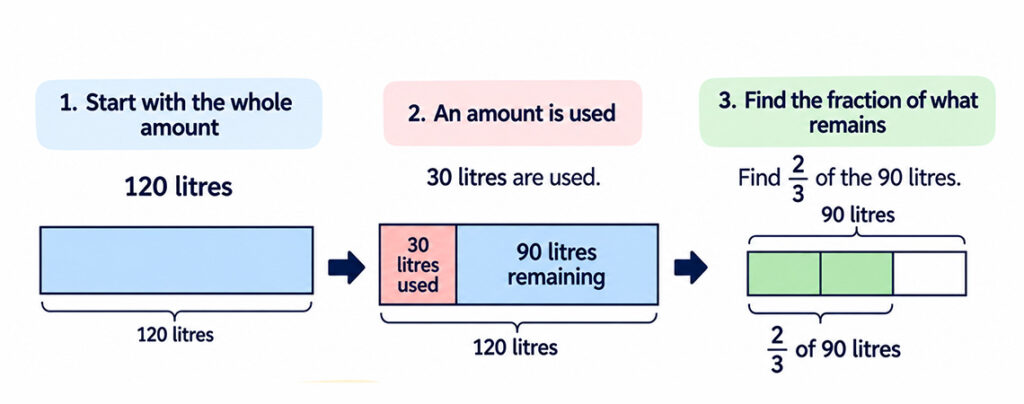
Fractions are introduced early in primary school, but the demands placed on them grow significantly by P5 and P6. At this level, children are expected to multiply and divide fractions and mixed numbers, apply fractions within multi-step word problems, and connect fraction thinking to ratio and percentage.
The most common difficulty is not the concept itself but the accumulation of small procedural errors: forgetting to convert mixed numbers, failing to simplify, or misidentifying the whole quantity. These errors are entirely fixable with targeted practice, but they tend to compound when left unaddressed.
Example: A typical PSLE-style question might ask a child to find a fraction of what remains after an amount has already been given away or used up. This changes the whole partway through the problem, so a child who anchors their working to the original quantity instead of the new remainder will carry that error through the rest of the problem.
Because fractions underpin ratio and percentage, weakness here has a knock-on effect across the entire upper primary syllabus. Addressing fraction gaps early saves considerable effort later. Our article on PSLE Maths topics that trip students up looks at how these procedural errors tend to surface under exam conditions.
Ratio and Proportion: When the Numbers Change
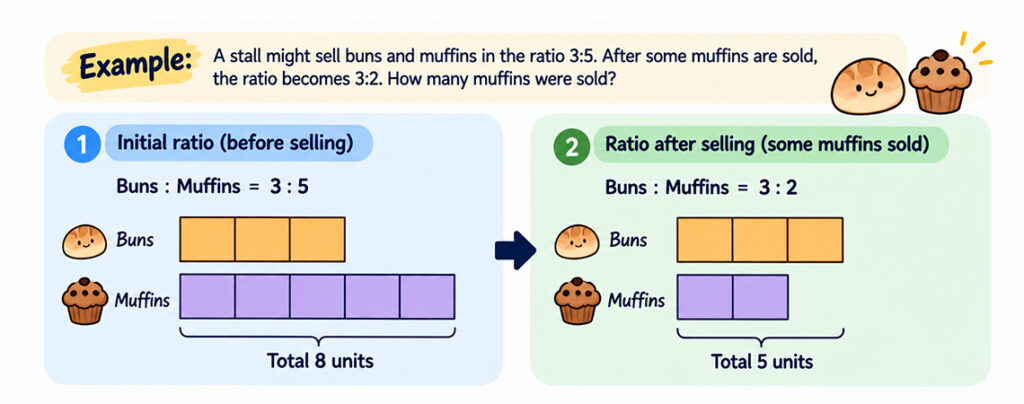
Ratio appears regularly in PSLE Maths papers, and it is also one of the most commonly misunderstood concepts. The concept itself is not complicated. But PSLE questions rarely present ratio in its simplest form.
The problems that catch students out are those where one or more quantities change. Without a clear method to anchor the working, these questions produce a high rate of errors even among students who understand ratio in principle.
Example: A stall might sell buns and muffins in the ratio 3:5. After some muffins are sold, the ratio becomes 3:2, and students are asked to work out how many muffins were sold. Questions like this require tracking a changing quantity carefully, rather than applying the ratio directly.
Drawing a model or table before attempting any calculation is the most reliable approach to ratio questions. Students who skip this step and work in their heads tend to make errors that a quick diagram would have prevented.
Percentage Word Problems: Finding the Right Whole
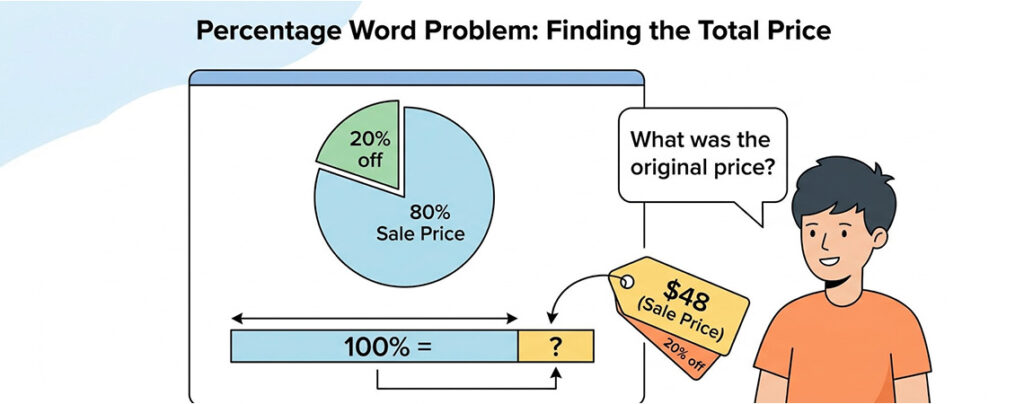
Percentage is a topic where students either feel confident or completely lost, and the dividing line is usually whether they can identify the correct base in a word problem.
Straightforward percentage questions ask: what is 20% of 80? These are manageable. The difficult PSLE-style questions describe a situation where the whole is not explicitly stated, or where the percentage refers to a changed quantity rather than an original one.
Example: A question might state that an item is reduced by 20% to a new price of $48, and ask for the original price. Students who simply calculate 20% of $48 arrive at the wrong answer, since the whole they need is the original price, not the discounted one.
Teaching children to ask one question before they begin working, what does 100% represent here, is a simple but powerful habit. It prevents the single most common percentage error, which is calculating the percentage of the wrong quantity.
Basic Algebra at P6
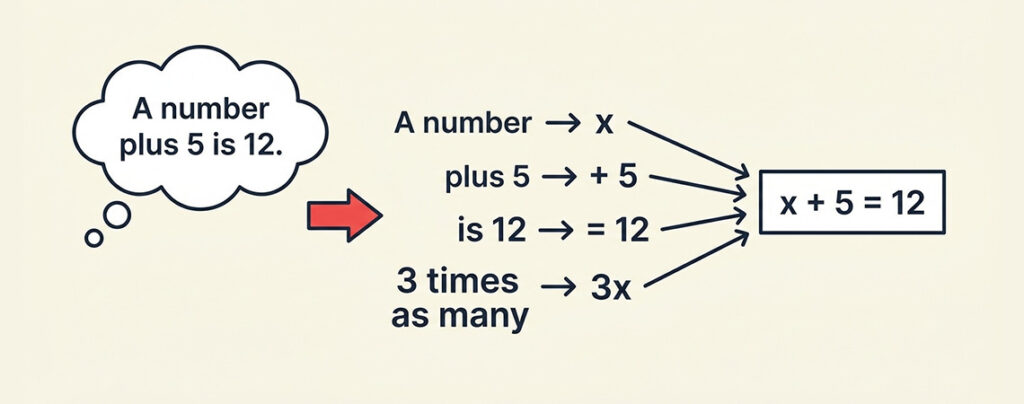
Algebra was formally incorporated into the primary Maths syllabus at P6 level, and it consistently produces anxiety in students who encounter abstract symbols for the first time. The transition from arithmetic to algebraic thinking requires a different kind of reasoning. The SEAB PSLE Mathematics syllabus outlines the specific algebraic competencies students are expected to demonstrate.
In most PSLE questions, algebra appears as a tool for expressing unknown quantities. The challenge is not solving an equation but forming one from a word problem. Many students can solve x + 5 = 12 with ease but struggle to write the equation in the first place when the problem is described in words.
Practising the translation step specifically, converting a written scenario into an algebraic expression before attempting any solving, builds this skill more effectively than working through completed examples alone. For a closer look at how algebra fits into the P6 syllabus, our guide to what changes in the P6 Maths syllabus explains this in more detail.
Geometry, Area and Perimeter
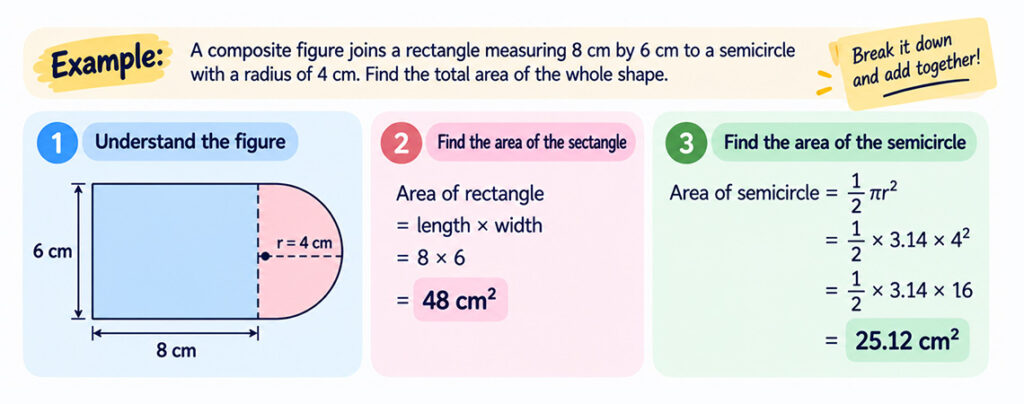
Geometry at PSLE level is rarely simple. Questions almost always involve composite figures, where students must identify the component shapes within a diagram, select the right formulas, and combine the calculations without making errors across multiple steps.
Students who know the formulas for area and perimeter often still struggle when those shapes are embedded within a complex diagram, when parts are shaded and parts are not, or when the question requires them to subtract one area from another.
Example: A composite figure might join a rectangle measuring 8 cm by 6 cm to a semicircle with a radius of 4 cm, and ask for the total area of the whole shape. Students need to calculate the rectangle and the semicircle separately, then add the two together, and a mistake in either part throws off the final answer.
The most effective preparation for geometry involves working through as many varied diagram types as possible. Each new arrangement reinforces the habit of reading the diagram carefully before writing anything down.
Model Drawing: Powerful but Demanding to Use Well
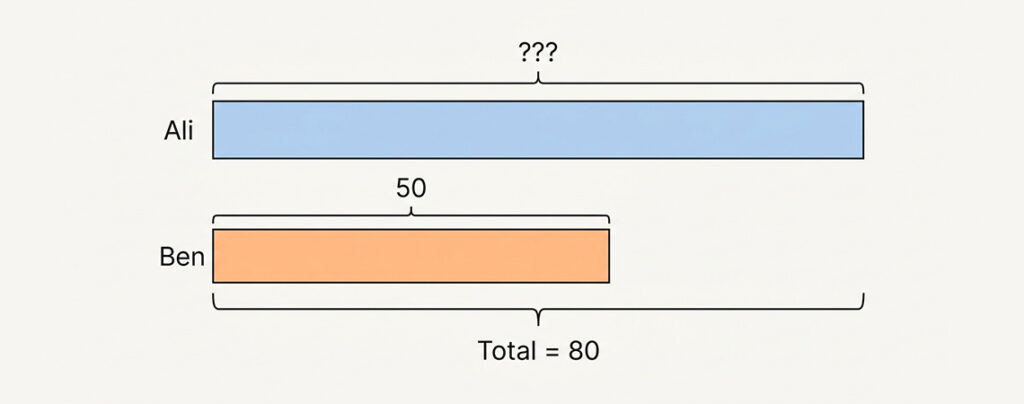
The bar model method is central to how Singapore Maths problems are designed and assessed. It is one of the most distinctive features of the local curriculum, and for good reason. A well-drawn model can unlock even a complex problem sum with minimal algebra.
The difficulty is that model drawing requires a child to fully understand the problem structure before drawing anything. Students who are uncertain about what the question is asking often draw incorrect models and then solve them accurately, arriving at a confidently wrong answer.
The skill develops with practice and patient guidance. Rather than defaulting to a model for every problem, students benefit most from learning to recognise when drawing one is genuinely useful and efficient. This judgement becomes as automatic as the drawing itself with enough exposure to varied question types.
When Topics Overlap
The hardest PSLE questions rarely test a single topic in isolation. A ratio question may also require fraction or percentage skills, and a geometry problem may hide a step of arithmetic reasoning within the diagram.
Often, the real difficulty is not the calculation itself but recognising which concepts and methods apply. This is why practice across mixed, unlabelled questions matters just as much as topical revision.
What Parents Can Do
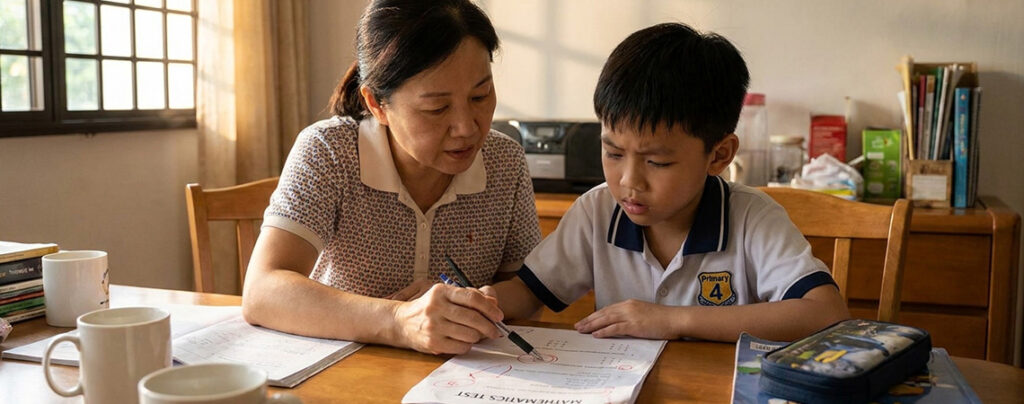
The most helpful thing parents can do is identify which of these topics is causing their child the most difficulty and address it directly, rather than using revision time on topics that are already secure.
- Track patterns, not just scores. Work through past PSLE papers and mark the results by topic. A single test result will not reveal much, but patterns across several papers will. If ratio errors appear over multiple months, ratio is the priority.
- Target the specific breakdown. A good tuition programme works through each difficult topic methodically, identifies exactly where a child’s understanding breaks down, and builds from that point rather than repeating the same explanations.
- Consider intensive revision when needed. A June or September holiday crash course can be an efficient way to close specific gaps before the PSLE.
Building Confidence in the Right Areas

None of these topics are beyond the reach of a primary school student with the right guidance and sufficient practice. They are hard for predictable reasons, and those reasons can be addressed with the right approach.
At Daniel’s Math Tuition, students work through these challenging topics in small groups of three to six, under the guidance of a tutor with ten years of teaching experience and a background as a former MOE school teacher. The focus is on genuine understanding rather than surface-level technique, so students carry their skills into the exam with real confidence. One-to-one and online tuition options are also available for families who prefer a more flexible arrangement, and fees are kept affordable so that quality support is accessible. The programme holds a 5.0 Google Rating, reflecting the consistent results students have achieved across P4 to P6.
Parents looking to address specific gaps can find out more on our P5 Maths Tuition and P6 Maths Tuition pages, or explore our full Primary Maths Tuition programme for younger levels.
Frequently Asked Questions
What is the hardest topic in PSLE Maths?
There is no single hardest topic, as this varies from child to child. That said, ratio, percentage, and algebra consistently challenge P5 and P6 students the most, largely because PSLE questions tend to combine several concepts within one problem rather than testing them in isolation.
How can my child improve at PSLE Maths word problems?
Start by identifying which specific topic is causing the most difficulty, rather than revising everything at once. Practising past PSLE papers under timed conditions, then reviewing mistakes by topic, is one of the most effective ways to build both accuracy and confidence.
What is the bar model method in Singapore Maths?
Start by identifying which specific topic is causing the most difficulty, rather than revising everything at once. Practising past PSLE papers under timed conditions, then reviewing mistakes by topic, is one of the most effective ways to build both accuracy and confidence.
Does PSLE Maths test more than one topic in a single question?
Yes, particularly in Paper 2. Many PSLE questions combine two or more topics, such as ratio with percentage or fractions with algebra, which is one of the main reasons these questions feel harder than the topics do on their own.