Primary 2 is where your child begins to build on the foundations set in P1, with new topics and slightly more complex problem-solving involved. Understanding what lies ahead can help you support your child more effectively at home.
This guide gives you a clear, topic-by-topic overview of the P2 Maths syllabus, so you know what to expect throughout the year.
What Is the P2 Maths Syllabus?
At this stage, building confidence is just as important as mastering new concepts. Many children begin to feel pressure when multiplication tables and fractions are introduced, so lessons focus on strengthening understanding steadily rather than rushing ahead.
The syllabus continues to be organised into three content strands: Number and Algebra, Measurement and Geometry, and Statistics.
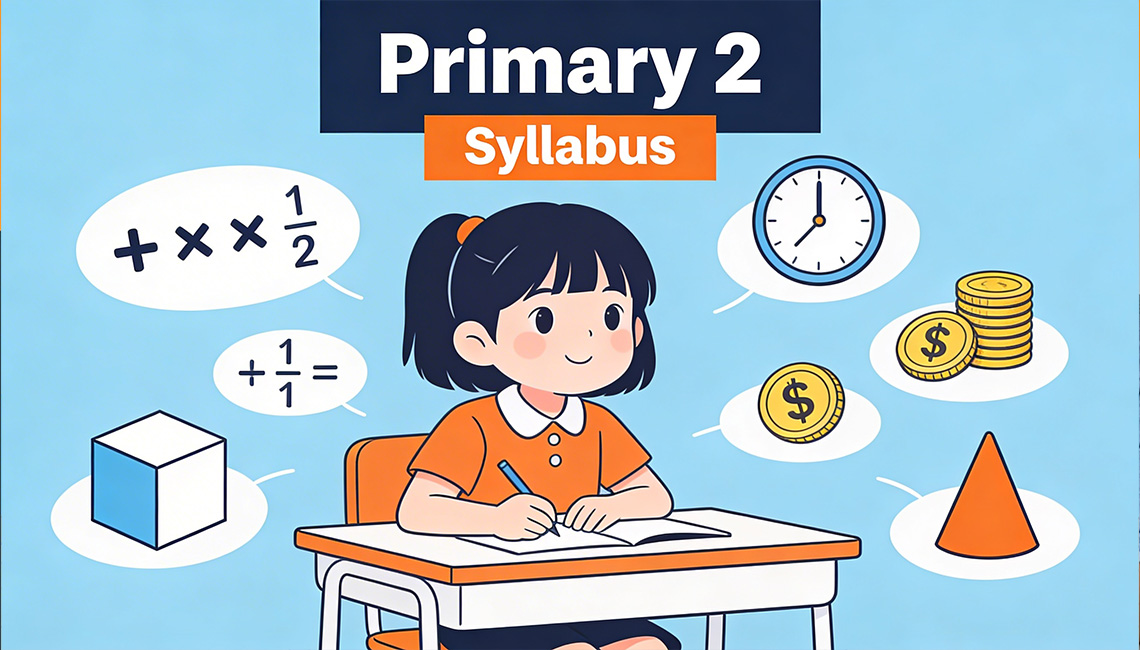
At this level, children are expected to work with larger numbers, handle money in dollars and cents, and begin exploring 3D shapes for the first time.
P2 Maths Syllabus Topics (2026)
Here is an overview of the key topics covered in the P2 Maths syllabus. For the full and detailed syllabus, you can refer to the official MOE document.
Topic | What Your Child Will Learn |
Numbers up to 1000 | Counting in tens and hundreds; place value (hundreds, tens, ones); reading and writing numbers; comparing, ordering, and number patterns; odd and even numbers |
Addition and Subtraction | Algorithms up to 3 digits; mental calculations involving 3-digit numbers and ones, tens, or hundreds |
Multiplication and Division | Multiplication tables of 2, 3, 4, 5, and 10; relationship between multiplication and division; multiplying and dividing within the multiplication tables; mental calculations |
Fractions | Understanding fractions as part of a whole; comparing and ordering unit fractions and like fractions; adding and subtracting like fractions within one whole |
Money | Counting dollars and cents; reading and writing money in decimal notation; comparing amounts; converting between decimal notation and cents |
Length, Mass and Volume | Measuring length in metres, mass in kilograms and grams, and volume in litres; comparing and ordering measurements |
Time | Telling time to the minute; measuring time in hours and minutes; converting between hours and minutes |
2D Shapes | Making and completing patterns with 2D shapes according to size, shape, colour, and orientation |
3D Shapes | Identifying, naming, and classifying 3D shapes including cube, cuboid, cone, cylinder, and sphere |
Picture Graphs with Scales | Reading and interpreting data from picture graphs with scales |
Common Challenges in P2 Maths
P2 introduces several new concepts that children can find challenging, particularly as the numbers get larger and the topics become more varied.
Multiplication tables. This is often the biggest hurdle at P2. Children are expected to know their times tables for 2, 3, 4, 5, and 10, and apply them fluently in both multiplication and division.
Fractions. Understanding fractions as part of a whole is a new concept at this level. Some children struggle with the idea that a smaller denominator does not mean a smaller fraction.
Money in decimal notation. Reading and writing amounts like $3.85 and converting between dollars and cents can trip children up, especially when they are still getting comfortable with place value.
Telling time to the minute. While time was introduced in P1, reading to the exact minute and converting between hours and minutes adds a new layer of difficulty.
These challenges are very manageable with consistent practice. The key is identifying where your child is struggling early, so the right support can be put in place.
How Daniel’s Maths Tuition Supports P2 Students
The jump from P1 to P2 can feel significant, especially with multiplication tables and fractions entering the picture for the first time. At Daniel’s Maths Tuition, our Primary 2 Maths tuition is designed to help children work through these new concepts at a comfortable pace, building confidence alongside understanding.
Small Group Classes: Our small class sizes mean your child gets individual attention in every lesson. Questions are encouraged and no child is left behind.
Taught by an Ex-MOE Teacher: Daniel is MOE-trained with over 10 years of teaching experience. He understands how the Singapore Maths curriculum builds progressively from lower primary to upper primary, and where students typically struggle.
Flexible Learning Options: We offer both in-person and online tuition to suit your family’s schedule. One-to-one private tuition is also available for children who need more focused support.
Affordable Fees: We keep our fees reasonable so that quality tuition remains accessible to more families.
Trusted by Parents: We are proud to hold a 5.0 Google Rating, reflecting the trust parents place in us and the progress their children make.
Parents who would like to explore whether the programme is suitable may arrange a trial lesson with no commitment required.
Frequently Asked Questions
Is P2 Maths harder than P1?
Yes, P2 builds on P1 and introduces new topics such as multiplication tables, fractions, and 3D shapes. Children who have a strong P1 foundation generally find the transition manageable, but those with gaps may find it more challenging.
When should I consider tuition for my P2 child?
If your child is struggling with their multiplication tables, showing frustration with fractions, or falling behind in class, it is worth considering support sooner rather than later. Early intervention prevents small gaps from becoming bigger ones.
Does Daniel's Maths Tuition follow the MOE syllabus?
Yes. All our lessons are fully aligned with the latest MOE curriculum, so your child’s tuition will complement what they are learning in school.