PSLE AL Score Guide: How the PSLE Scoring System Works for Your Child
The PSLE AL score plays a key role in determining your child’s secondary school options.
Since 2021, Singapore has adopted the Achievement Level (AL) scoring system, replacing the old T-score method with a simpler and fairer approach. With PSLE 2026 approaching, understanding how this system works and how your child can improve is more important than ever.
Many parents ask:
-
How is the PSLE score calculated?
-
What is a good AL score?
-
How can my child improve their PSLE results?
This guide explains everything clearly — and how to prepare effectively, especially for PSLE Math, which often has the biggest impact on overall performance.
What is the PSLE AL Scoring System?
Under the Achievement Level system, students are graded by bands instead of being ranked against their peers.
Each subject receives one AL grade:
-
English
-
Mother Tongue
-
Mathematics
-
Science
Grades range from AL1 (best) to AL8 (weakest).
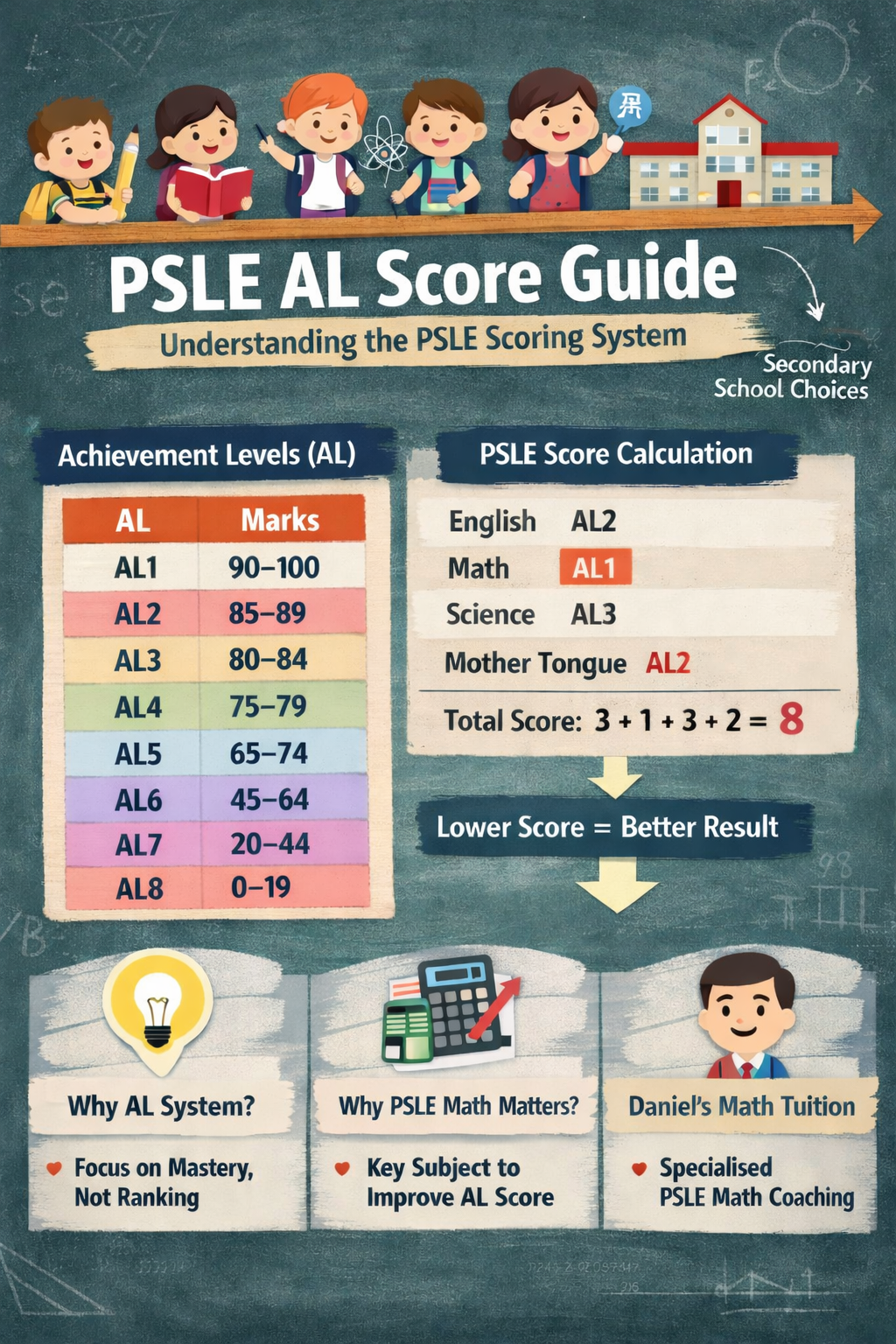
Achievement Level Table
| AL | Marks |
|---|---|
| AL1 | 90–100 |
| AL2 | 85–89 |
| AL3 | 80–84 |
| AL4 | 75–79 |
| AL5 | 65–74 |
| AL6 | 45–64 |
| AL7 | 20–44 |
| AL8 | 0–19 |
Your child’s four scores are added together to form the PSLE Score.
Lowest score = best result
Range: 4 to 32
How is the PSLE Score Calculated?
Example:
English AL2
Mother Tongue AL2
Math AL1
Science AL3
Total score = 8
This total score determines which secondary schools your child is eligible for during the posting exercise. Even a single point improvement can open up different school options.
This total determines eligibility for secondary schools during the posting exercise.
Even a 1-point improvement can make a difference.
Why Did MOE Introduce the AL System?
The previous T-score system ranked students very closely against one another, sometimes by just a mark or two, which created unnecessary stress and competition.
This caused:
-
unnecessary pressure
-
over-competition
-
stress over tiny differences
The AL system shifts the focus to mastery of content, not comparison with peers. Students are rewarded for what they genuinely understand, rather than where they stand in the cohort.
For PSLE 2026 candidates, this means consistent preparation and solid fundamentals matter far more than last-minute cramming.
This supports:
✓ healthier learning
✓ stronger foundations
✓ more confidence
Why PSLE Math Has the Biggest Impact
Maths is often the subject where students have the most room to improve, quickly and measurably.
Unlike some subjects, Maths questions are structured, techniques are trainable, and accuracy builds rapidly with the right practice. Moving even one AL band (for example, from AL4 to AL3) can meaningfully change a child’s school options.
This is why building strong Maths foundations early and addressing gaps before the PSLE 2026 exam makes such a difference.
Common Reasons Students Lose Marks in PSLE Math
Most students do not struggle because they are weak. Often, they have missed certain foundational concepts along the way.
Common issues include:
-
Shaky fraction and ratio understanding
-
Losing marks on multi-step word problems
-
Careless errors under time pressure
-
Unfamiliarity with exam technique
The good news is that these are all trainable with the right guidance.
How Daniel’s Math Tuition Supports PSLE Students
At Daniel’s Math Tuition, we specialise purely in Mathematics. With over 10 years of teaching experience and a background as a former MOE school teacher, Daniel provides focused, structured support for Primary students preparing for PSLE.
Our lessons emphasise:
-
clear concept explanation
-
step-by-step problem solving
-
heuristics for word problems
-
exam strategies and time management
-
small group guidance and close support
Many students don’t struggle because they are weak — they simply missed some basics earlier.
Once gaps are fixed, confidence and scores improve naturally.
Our goal is simple:
help students move up one or two AL bands steadily, without stress or last-minute cramming.
Frequently Asked Questions (FAQs)
What is considered a good PSLE AL score?
Generally:
-
4–8 → top schools
-
9–14 → strong options
-
15–20 → average range
Lower scores are better.
Is the AL system easier than T-score?
Not easier — just fairer.
Students are graded by mastery, not compared to others.
Can one subject really change the overall score?
Yes.
Improving just one subject by 1 AL band lowers the total score by 1 point, which can affect school eligibility.
Why do many students lose marks in PSLE Math?
Common issues:
-
weak fraction foundations
-
careless mistakes
-
poor word problem strategy
-
lack of exam technique
These are trainable skills.
When should my child start PSLE Math tuition?
Ideally Primary 4 or early Primary 5.
Starting earlier builds confidence and reduces stress in Primary 6.
Do you offer trial lessons?
Yes. Parents can arrange a trial class to see if our teaching style suits their child.
If you’re looking for focused PSLE Math tuition in Singapore, feel free to reach out anytime. Small group PSLE Math classes available in Singapore.
Message Daniel directly to check available slots or arrange a trial.