Primary 5 is widely considered one of the most challenging years in a child’s primary school journey. The Maths syllabus expands considerably, with new topics such as percentage, rate, and volume added to an already demanding workload.
This guide gives you a clear overview of the P5 Maths syllabus, so you
What Is the P5 Maths Syllabus?
At this stage, managing pressure is just as important as mastering content. As PSLE approaches, many students begin to feel anxious about their performance. Lessons focus on strengthening clarity, improving structured problem-solving, and rebuilding confidence step by step.
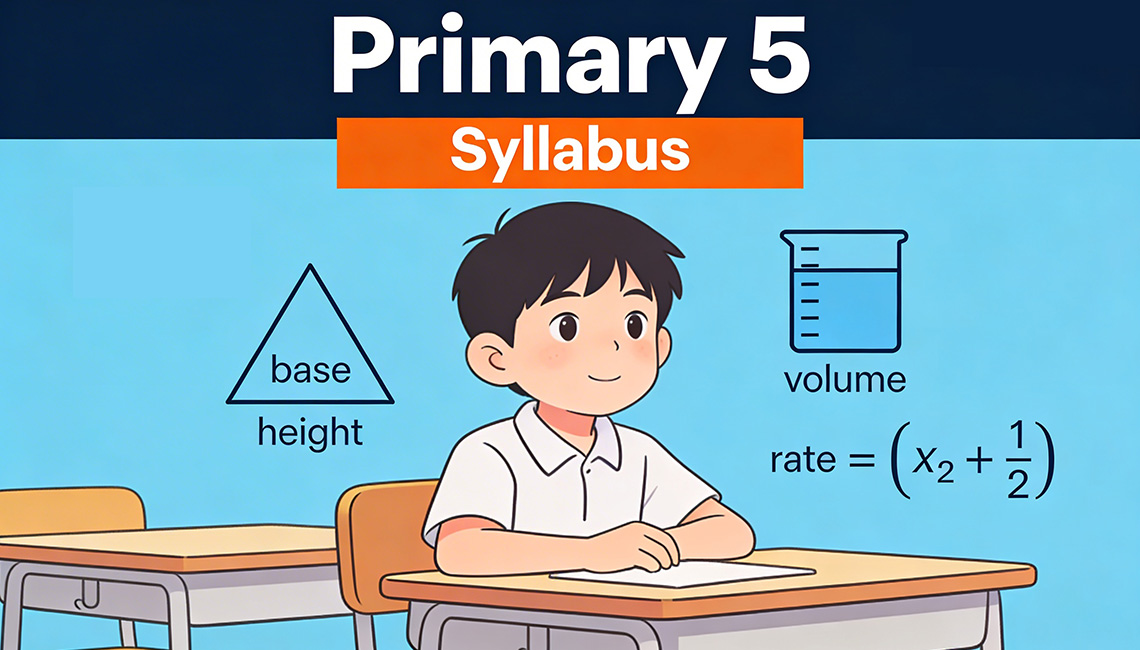
At this level, children work with numbers up to 10 million, are introduced to percentage and rate, and tackle more advanced geometry involving triangles, parallelograms, and volume.
P5 Maths Syllabus Topics (2026)
Here is an overview of the key topics covered in the P4 Maths syllabus. For the full and detailed syllabus, you can refer to the official MOE document.
Topic | What Your Child Will Learn |
Numbers up to 10 Million | Reading and writing numbers in numerals and words |
Four Operations | Multiplying and dividing by 10, 100, 1000 and their multiples; order of operations; use of brackets |
Fractions | Dividing a whole number by a whole number with a fraction as the quotient; adding and subtracting mixed numbers; multiplying fractions and mixed numbers by whole numbers and other fractions |
Decimals | Multiplying and dividing decimals by 10, 100, and 1000; converting measurements between units in decimal form |
Percentage | Expressing a part of a whole as a percentage; finding a percentage of a quantity; finding discount, GST, and annual interest |
Rate | Understanding rate as a quantity per unit; finding rate, total amount, or number of units given the other two |
Area of Triangle | Concepts of base and height; finding the area of triangles and composite figures |
Volume of Cube and Cuboid | Measuring volume in cubic units, cm³ and m³; finding the volume of cubes, cuboids, and liquid in a rectangular tank |
Angles | Angles on a straight line, angles at a point, and vertically opposite angles; finding unknown angles |
Triangles | Properties of isosceles, equilateral, and right-angled triangles; angle sum of a triangle; finding unknown angles |
Parallelogram, Rhombus and Trapezium | Properties of these shapes; finding unknown angles |
Common Challenges in P5 Maths
P5 is the year when gaps from earlier years tend to become most apparent. The syllabus moves quickly and many topics require children to draw on prior knowledge across multiple areas.
Fractions involving multiplication. Multiplying proper fractions, improper fractions, and mixed numbers is a significant step up from P4. Children who are not confident with equivalent fractions and simplification will find this particularly difficult.
Percentage. While the concept of percentage is straightforward, applying it to real-world contexts such as discount and GST requires careful reading and multi-step reasoning.
Rate. Rate is a new topic at P5 and involves understanding the relationship between two different quantities. Many children find it abstract at first, especially when applied to word problems.
Area of triangles and composite figures. Identifying the correct base and height of a triangle is not always intuitive, and composite figures add another layer of complexity.
Finding unknown angles. Questions involving angles at a point, angles on a straight line, and properties of triangles often require children to work through several steps before arriving at an answer.
With PSLE just around the corner, P5 is also the year where it becomes harder to catch up if gaps are left unaddressed. Early support goes a long way in keeping your child on track.
How Daniel’s Maths Tuition Supports P5 Students
P5 is the year when many families decide to seek tuition, and timing matters. At Daniel’s Maths Tuition, our Primary 5 Maths tuition is designed to help children strengthen their understanding of core topics while also developing the problem-solving skills they will need for PSLE.
Small Group Classes: Our small class sizes ensure every child gets the individual attention they need. Complex topics like percentage, rate, and unknown angles are broken down clearly so children genuinely understand rather than just memorise.
Taught by an Ex-MOE Teacher: Daniel is MOE-trained with over 10 years of teaching experience. He understands the upper primary syllabus thoroughly and knows how to prepare students strategically for PSLE.
Flexible Learning Options: We offer both in-person and online tuition to suit your family’s schedule. One-to-one private tuition is also available for children who need more focused support heading into the upper primary years.
Affordable Fees: We keep our fees reasonable so that quality tuition remains accessible to more families.
Trusted by Parents: We are proud to hold a 5.0 Google Rating, reflecting the progress our students consistently make and the trust parents place in us.
Parents who would like to explore whether the programme is suitable may arrange a trial lesson with no commitment required.
Frequently Asked Questions
Is P5 Maths much harder than P4?
Yes, P5 is a significant step up. New topics such as percentage, rate, and volume are introduced alongside more complex fractions and geometry. It is also the year when PSLE preparation begins in earnest, which adds to the pressure.
When should I consider tuition for my P5 child?
If your child is struggling with fractions, finding percentage or rate confusing, or losing confidence as the year progresses, it is worth seeking support early. P5 content feeds directly into PSLE, and leaving gaps unaddressed can make P6 significantly harder.
Does Daniel's Maths Tuition follow the MOE syllabus?
Yes. All our lessons are fully aligned with the latest MOE curriculum, so your child’s tuition will complement what they are learning in school.