

Exam season can feel daunting, and for many students, maths remains the most challenging core subject. But here’s the reality: success in PSLE and O Level Maths isn’t about being naturally gifted. It’s about using the right strategies and building solid foundations.
Starting early in your exam preparation helps build confidence, addresses weaknesses, and ensures you’re well-prepared for this essential subject. These nine practical tips address the most common struggles students face, from mastering fundamentals to managing exam pressure.
1. Understand the Basics Before Moving Forward

Strong fundamentals drive exam performance. Build these well before tackling problem sums. Many students rush to tackle difficult questions without mastering fundamental concepts, leading to confusion and repeated mistakes.
For PSLE students, thoroughly understand whole numbers, fractions, decimals, percentages, ratios, and basic geometry before attempting complex problem sums. These fundamentals appear in approximately 60% of PSLE questions. If you need structured support, primary math tuition provides personalised guidance to master these concepts.
O Level students need solid grasp of algebraic manipulation, factorisation, equation solving, and basic trigonometry. Gaps in basics create compounding difficulties later. For comprehensive support, secondary math tuition offers targeted help in strengthening essential skills.
Master each concept completely before progressing. Work through textbook examples systematically, ensuring you understand not just how to apply formulas but why they work. Use visual aids and real-life examples to anchor abstract ideas.
Test your understanding by explaining concepts to someone else. If you can teach a topic clearly, you’ve mastered it. If you struggle to explain it, that area needs more work.
2. Solve Past Exam Papers Regularly
Past exam papers reveal exactly what examiners expect, the question formats you’ll face, and topics that appear most frequently. Start with papers from the last 3-5 years for the best indication of current trends.
For comprehensive access to quality past papers, visit Daniel’s Math Tuition exam papers collection. Having centralised resources saves time and ensures you’re practising with relevant materials.
When solving past papers, don’t just check if your answer is correct. Study marking schemes to understand how marks are allocated. Notice which steps earn method marks and what level of detail examiners expect.
Complete papers in three phases: untimed for understanding, loosely timed for pacing, then full exam conditions with strict timing. After each paper, analyse your performance. Which topics caused difficulties? What types of mistakes dominated? This transforms practice into strategic improvement.
The Singapore Examinations and Assessment Board (SEAB) provides official syllabus documents and exam formats to guide your preparation.
3. Practise Consistently Rather Than Cramming

Consistent daily practice beats marathon study sessions. Your brain consolidates mathematical understanding through regular exposure, not overnight cramming.
Establish a daily practice routine of 45-90 minutes depending on your level. Use the 10-10-10 Method: solve 10 similar questions, review 10 mistakes from previous sessions, and spend 10 minutes on mental maths.
Mix topics rather than drilling the same concept repeatedly. Research from Cornell University’s Learning Strategies Center shows that interleaving produces 15-25% better retention than blocked practice. Alternate between algebra, geometry, and word problems.
Start serious revision at least 6-8 weeks before PSLE and 12-18 weeks for O Levels. This timeline allows proper spacing between sessions for memory consolidation.
4. Prioritise Sleep and Rest for Peak Performance

Sleep isn’t optional. Research shows sleep deprivation reduces exam performance by up to 25%. Aim for 7-9 hours nightly, especially in the weeks leading to exams.
During sleep, your brain processes information, strengthens neural connections, and restores cognitive functions like attention and memory. The night before your exam, get 7-8 hours minimum. This matters far more than last-minute revision.
Take regular breaks during study sessions using the Pomodoro Technique: 25 minutes focused study, 5-minute breaks. After four cycles, take 15-30 minutes off.
Stay physically active with 30 minutes of exercise daily. Physical activity reduces stress hormones by 30% and improves sleep quality. Even a brisk walk makes a significant difference.
5. Time Yourself During Practice Sessions

Practising without time pressure doesn’t prepare you for real exam conditions. Start timing yourself early. In the final 2-3 weeks, every practice paper should be completed under strict exam conditions.
For PSLE, allocate approximately one minute per mark. Paper 1 (45 marks in 60 minutes) requires 45 minutes for solving, 15 minutes for checking. Paper 2 (55 marks in 90 minutes) allows 1.5 minutes per mark, with 20 minutes for review.
O Level students face 90 marks in 135 minutes per paper. Use a three-phase approach: first pass for confident questions (50-60 minutes), second pass for difficult questions (40-50 minutes), final review (20-25 minutes).
| Paper | Total Marks | Duration | Time Per Mark |
| PSLE Paper 1 | 45 | 60 minutes | ~1 minute |
| PSLE Paper 2 | 55 | 90 minutes | ~1.5 minutes |
| O Level Paper | 90 | 135 minutes | ~1.5 minutes |
The skip-and-return strategy proves essential. When stuck beyond your allocated time plus 2-3 minutes, mark it clearly and move forward. Those “stuck” minutes could earn easier marks elsewhere.
The skip-and-return strategy proves essential. When stuck beyond your allocated time plus 2-3 minutes, mark it clearly and move forward. Those “stuck” minutes could earn easier marks elsewhere.
Track your timing across multiple papers to identify where you consistently struggle with time management.
6. Identify Maths Concepts to Know Which Methods to Use
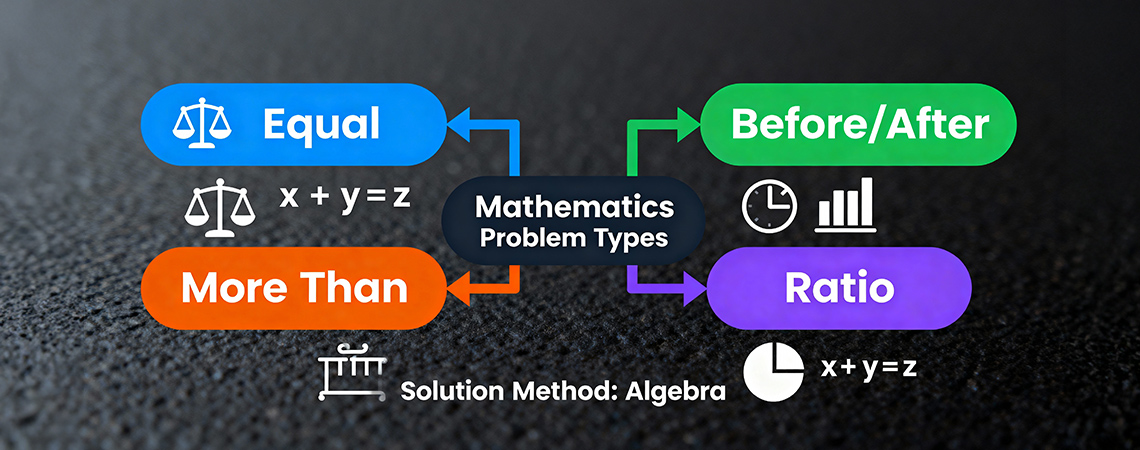
Recognising the underlying mathematical concept determines which solving method to apply. Approximately 50% of PSLE and O Level questions follow familiar patterns despite different surface details.
Learn to spot keywords: “Equal” or “same” indicates equal concept problems. “Before/after” signals comparison of states. “More than” or “less than” implies comparison. “For every” or “per” suggests ratio problems.
For PSLE students, master core heuristics: model drawing, unitary method, assumption method, before-after concept, equal concept, and excess/shortage. Singapore’s Ministry of Education emphasises these as essential tools.
O Level students must identify whether questions require algebraic manipulation, simultaneous equations, quadratic formula, trigonometric identities, or probability rules.
Practice this separately. Take 10 past paper questions and classify them by concept before solving. This enables quick strategy selection during exams.
7. Identify Your Strengths and Weaknesses Early

Self-awareness enables strategic revision. Complete diagnostic tests or review recent exam results to identify patterns. Which topics repeatedly cause difficulties? Where do you lose most marks?
Create a spreadsheet tracking performance by topic. After each session, record accuracy rate and time taken. This reveals true strengths and weaknesses.
Prioritise weak areas without neglecting strong ones. Allocate 60-70% of study time to weak topics, 30-40% to maintaining strengths.
Working with an experienced tutor accelerates this process dramatically. A qualified educator identifies misconceptions, recognises error patterns, and provides targeted exercises.
At Daniel’s Math Tuition, our former MOE teachers with 10 years of experience excel at pinpointing weaknesses and designing personalised plans. Our small group classes ensure individual attention, while 24/7 WhatsApp support means you’re never stuck.
Whether you need support for primary school mathematics or secondary level topics, choosing a reputable tuition centre provides access to experienced teachers and structured learning.
Parents play a vital role by encouraging consistent practice and creating positive study environments. Open communication between parents, teachers, and students provides encouragement throughout the journey.
8. Use Graphs and Diagrams to Visualise Problems

Visual representation transforms abstract concepts into concrete images. Many students struggle because they try solving problems purely mentally without externalising their thinking.
For PSLE students, bar models are essential tools. Singapore’s mathematics curriculum emphasises model drawing because it helps visualise relationships between quantities.
Draw bar models for ratio problems, fraction problems, percentage comparisons, and word problems involving comparison or change. Even when your final answer is wrong, a well-drawn, clearly labelled bar model earns method marks.
O Level students benefit from different visual tools. Sketch graphs showing key features like intercepts and turning points. Draw clear geometry diagrams marking all given information. Use tree diagrams for probability questions.
Label everything clearly. Write what each segment represents and what you’re trying to find. Practice drawing quickly but accurately.
9. Always Show Your Working Clearly

Many students skip working steps to “save time.” This backfires badly. PSLE and O Level marking schemes award substantial method marks, often 2-3 marks per question even when your final answer is incorrect.
Every calculation step must appear on paper. Write number statements showing where values come from. Show: “Speed of Car A = 60 km/h” then “Distance = Speed × Time = 60 × 2 = 120 km.”
For O Level students, examiners award “error carried forward” marks. If your part (b) working correctly follows from a wrong part (a) answer, you can still earn full marks. But only if working is clearly shown.
Show formulas before substituting values. Write “Area = ½ × base × height” before plugging in numbers. This demonstrates you know which formula applies.
Keep working neat with proper spacing. Number your steps for multi-part questions. Cross out mistakes with a single line rather than scribbling.
Box or underline final answers. Include units in all answers. Writing “120” instead of “120 km” loses marks. Take time at the end to double check your work.
Your Action Plan Starting Today
Daniel’s Math Tuition helps students strengthen concepts, improve problem-solving skills, and perform confidently in exams. Our approach is structured, patient, and proven. If you’d like to discuss your child’s learning needs, reach out to us anytime.
Ready to improve your maths performance? Contact Daniel’s Math Tuition today and discover how our expert tutors support students in building the knowledge and confidence needed for success.