
Most parents know that Primary Maths grows more demanding as the years go on. But few anticipate just how sharply the difficulty climbs by P5 and P6. PSLE Maths does not simply test memory. It tests how well a child can apply concepts across unfamiliar and often multi-step problem types.
The good news is that most of the topics students struggle with are predictable. Understanding where the difficulty lies is the first step to addressing it effectively.
Below are the four areas that consistently cost students marks, along with what is actually going wrong and what you can do about it. For a full overview of what the primary curriculum covers, the MOE Primary Mathematics Syllabus is a useful reference point.
1. Fractions and Percentages
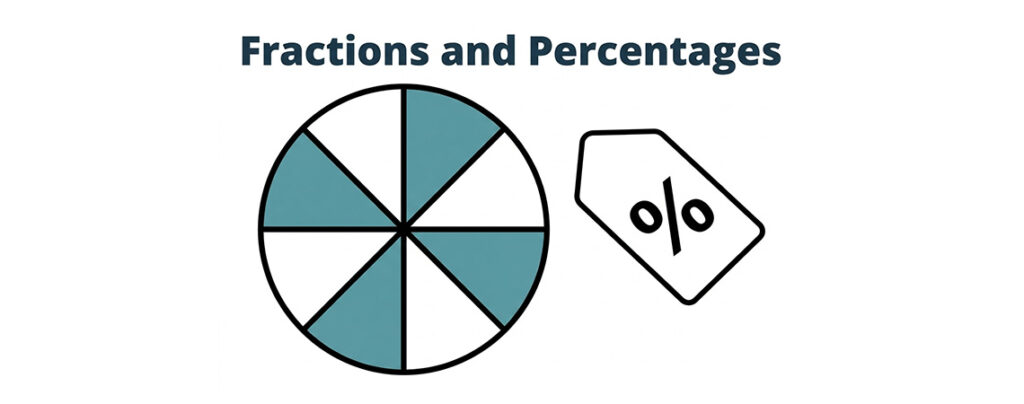
These two topics look different on the surface but share the same root problem: students lose track of what the whole is.
With fractions, the trouble usually starts with mixed numbers. A student who can handle 3/4 + 1/2 without much difficulty will often stumble when the question involves 2 1/3 multiplied by 1 3/4. The fix is not optional: mixed numbers must be converted to improper fractions before any multiplication or division is attempted. Skipping this step is one of the most consistent mark-losing habits at P6 level.
With percentages, the challenge is less about calculation and more about identification. PSLE questions rarely hand students the base figure directly. Instead, they describe a situation and expect students to work out what 100% refers to before setting up any working. A question might say “after a 20% discount, the price was $48” and ask for the original price. Students who jump straight to calculating 20% of $48 will get the wrong answer every time.
What helps: Before touching numbers, ask your child two questions for every percentage or fraction problem: “What is the whole?” and “What part are we talking about?” These two questions, asked consistently, prevent the majority of errors in both topics.
2. Ratio and the Changing Ratio Problem
Ratio is the topic that catches the most P5 and P6 students off guard, and it is easy to see why. Simple ratio questions are straightforward. The PSLE versions are not.
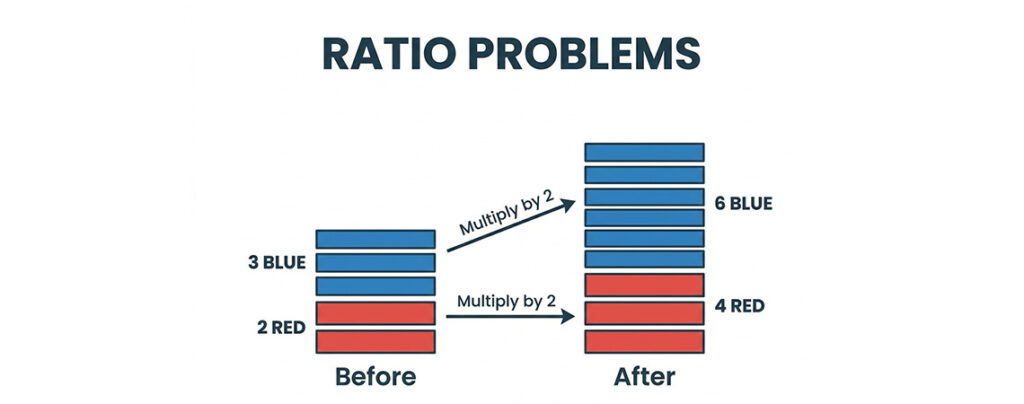
The classic difficulty is the changing ratio problem, where one quantity changes while another stays constant, or both quantities change but at different rates. For example: “Ali and Ben share some marbles in the ratio 3:5. After Ali gives 12 marbles to Ben, the ratio becomes 1:3. How many marbles did Ali have at first?”
Students who try to compare the two ratios directly, without first identifying the unchanged quantity, will almost always set up the problem incorrectly. The right approach is to make the unchanged value consistent across both ratios before forming any equation. This is a technique that requires guided practice, not just repeated attempts.
A second common error is with ratio and fractions combined. Questions that say “1/4 of Ali’s share equals 1/3 of Ben’s share” require students to shift between two different representations of the same relationship. Many children can handle one or the other but not both at once.
What helps: Teach your child to write out both ratios clearly and look for the quantity that has not changed before doing anything else. Drawing a simple table or timeline showing “before” and “after” values can prevent the most common ratio errors. This is one of the core focus areas in our P6 Maths Tuition programme, where students work through these problem types systematically until the approach becomes reliable.
3. Algebra and Word Problem Setup
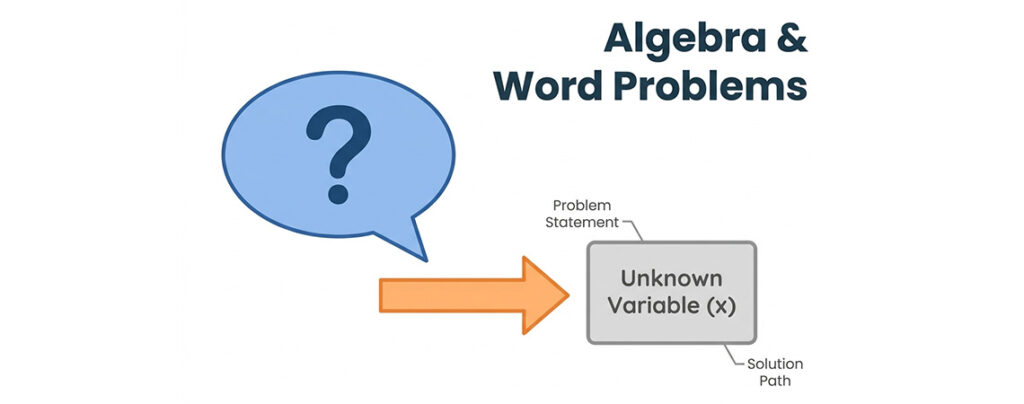
Algebra was added to the primary syllabus to give students a more structured way to solve complex problems. In practice, many P6 students find the algebra itself manageable once it is set up. The part that breaks down is the setup.
Translating a word problem into an algebraic expression is a genuinely distinct skill. It requires a child to read a paragraph, identify the unknown, assign it a letter, and then express every other quantity in the problem in terms of that letter. A question might read: “Priya has 3 times as many stickers as Ravi. After Priya gives away 15 stickers, she has twice as many as Ravi. How many stickers does Ravi have?” Students who can solve an equation fluently will still drop marks if they cannot form the equation in the first place.
A specific error worth noting: students often assign the letter to the wrong unknown. Choosing what to call “x” is not arbitrary. Assigning x to the quantity that appears most frequently in the problem tends to simplify the working considerably.
Another common pitfall is forgetting to answer what the question actually asked. A student might correctly solve for x but then stop there, when the question asked for a different quantity expressed in terms of x.
What helps: Practise the setup step in isolation. Give your child a word problem and ask them only to write the equation, not solve it. Once forming the expression consistently feels natural, solving becomes much less error-prone. Our Primary Maths Tuition programme devotes structured time to this exact step, particularly for students in P5 and P6.
4. Geometry, Composite Figures, and the Bar Model
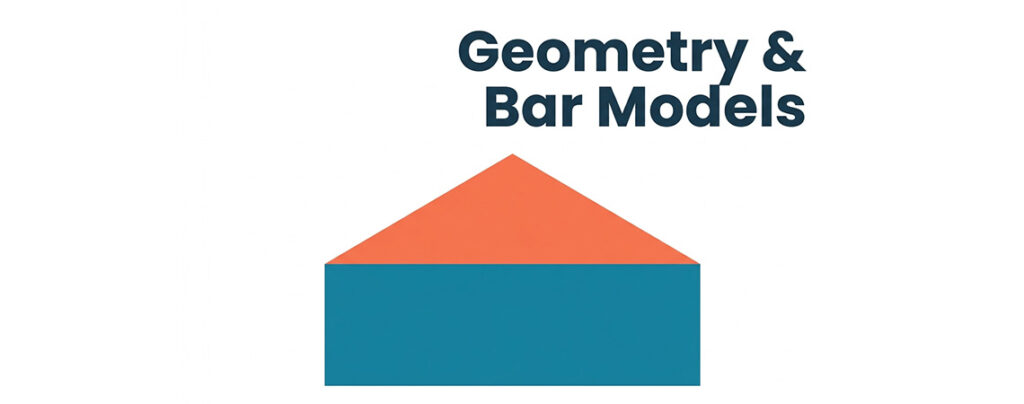
These three areas are grouped here because they share a common underlying challenge: students know the individual concepts but cannot hold them together when problems require more than one at a time.
Geometry and composite figures: At PSLE level, geometry questions almost never involve a single shape. They involve two or three shapes combined, overlapping, or cut out of one another. A student who knows the formula for the area of a triangle and the area of a circle separately may still struggle to find the shaded region in a figure that combines both, because they cannot identify which parts to add and which to subtract. The key skill is decomposition: breaking the figure into parts you can name and calculate individually. Students who draw and label every component before calculating make far fewer errors than those who try to hold the diagram in their head.
Bar models: The bar model is not just a primary school technique. It is a precise visual language for representing relationships between quantities. Done well, a bar model makes the structure of a problem visible in a way that abstract numbers cannot. The issue is that students who use bar models inconsistently, drawing them only when they are stuck, tend to draw them poorly precisely when they need them most. The habit has to be built earlier, on easier questions, so that it is instinctive by the time problems become genuinely hard.
A specific bar model error worth watching: students sometimes draw bars of arbitrary length that do not accurately reflect the ratios in the problem. If the problem says A is twice B, the bar for A must be drawn visibly longer, not approximately the same length. Inaccurate models lead to incorrect readings and wrong answers even when the concept is understood.
What helps: For geometry, make labelling every known measurement onto the diagram a non-negotiable first step before any calculation begins. For bar models, build the habit on straightforward problems in P3 and P4 rather than waiting until P6. Ask your child to draw a model for every problem sum, even the ones they find simple.
Building the Right Foundation Before Exam Season

Consistent, targeted practice in these four areas can shift a child’s performance meaningfully before PSLE Maths. The patterns behind most errors are predictable, and with the right guidance, they are correctable.
Parents can support this at home by reviewing marked work regularly and asking one simple question when a mistake appears: “Where exactly did the working go wrong?” Identifying the precise point of error, whether it is the setup, the calculation, or the final answer, makes revision far more targeted than simply redoing the whole question.
For families looking for more structured support, we offer small group sessions led by a tutor with ten years of teaching experience, including a background as a former MOE school teacher. In 2025, 80% of PSLE students under his guidance achieved AL1 to AL3, a result that reflects a consistent and methodical approach to these exact topics.
Class sizes are kept small deliberately, so each child receives genuine attention rather than being lost in a crowd. Fees are also set to remain accessible for most families, without compromising on quality.
Whether your child needs to close a specific gap or build overall confidence before the big day, explore our P5 Maths Tuition and P6 Maths Tuition pages to find out how we can help. You are also welcome to contact us directly. A trial class is available for new students.