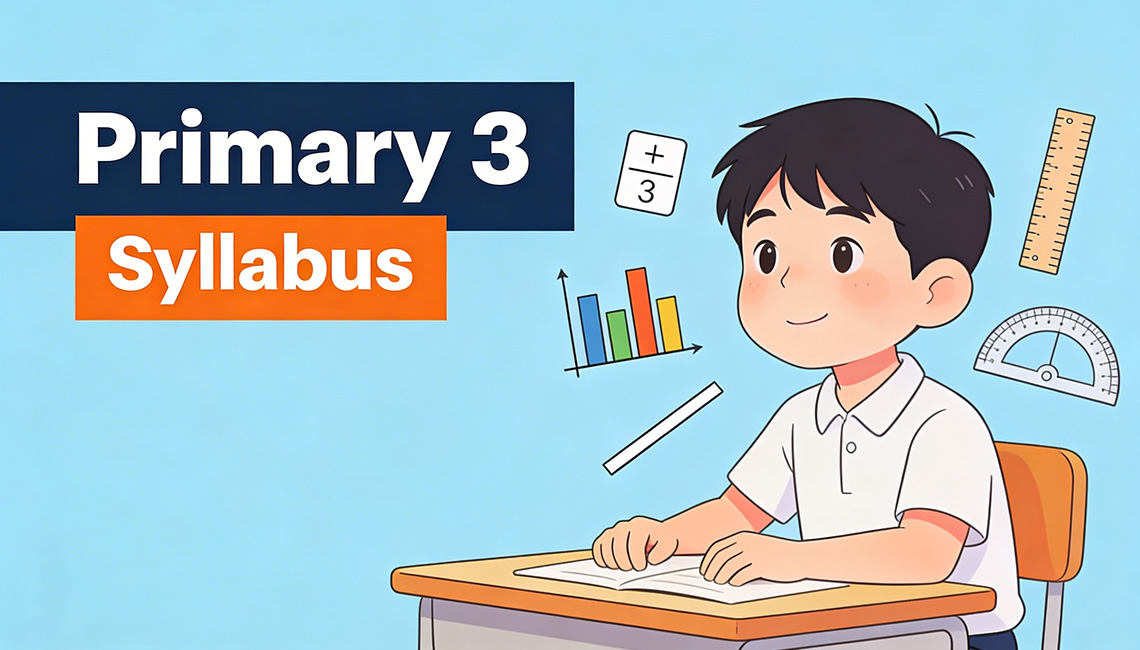
Primary 3 marks an important turning point in your child’s Maths journey. The syllabus becomes noticeably more demanding, with new topics, larger numbers, and multi-step problem-solving becoming part of everyday learning.
This guide gives you a clear overview of the P3 Maths syllabus, so you know what to expect and how to support your child through the year.
What Is the P3 Maths Syllabus?
At this stage, maintaining confidence is just as important as keeping up with the syllabus. As topics become more demanding, children benefit from steady reinforcement and clear explanations that help them feel in control of their learning again.
At this level, children work with numbers up to 10,000, are introduced to geometry concepts such as angles and perpendicular lines, and begin measuring time, length, mass, and volume in compound units.
P3 Maths Syllabus Topics (2026)
Here is an overview of the key topics covered in the P3 Maths syllabus. For the full and detailed syllabus, you can refer to the official MOE document.
Topic | What Your Child Will Learn |
Numbers up to 10,000 | Counting in hundreds and thousands; place value (thousands, hundreds, tens, ones); reading, writing, comparing, and ordering numbers; number patterns |
Addition and Subtraction | Algorithms up to 4 digits; mental calculations involving two 2-digit numbers |
Multiplication and Division | Multiplication tables of 6, 7, 8, and 9; division with remainder; multiplication and division algorithms up to 3 digits by 1 digit; mental calculations |
Fractions | Equivalent fractions; expressing fractions in simplest form; comparing and ordering unlike fractions; adding and subtracting related fractions within one whole |
Money | Adding and subtracting money in decimal notation |
Length, Mass and Volume | Measuring in kilometres and millilitres; compound units; converting between larger and smaller units |
Time | Measuring time in seconds; finding starting time, finishing time, or duration; 24-hour clock |
Area and Perimeter | Concepts of area and perimeter; measuring area in square units, cm² and m²; perimeter of rectangles, squares, and rectilinear figures; area of rectangles and squares |
Angles | Concept of angles; identifying right angles and angles greater or smaller than a right angle |
Perpendicular and Parallel Lines | Identifying and drawing perpendicular and parallel lines |
Bar Graphs | Reading and interpreting data from bar graphs with different scales |
Common Challenges in P3 Maths
P3 is often the level where parents first notice their child beginning to struggle. The jump in difficulty is real, and a few topics in particular tend to catch children off guard.
Multiplication tables of 6, 7, 8, and 9. These are harder to memorise than the earlier tables and are foundational for division and future topics. Children who have not fully mastered them often find problem-solving much harder.
Fractions. Equivalent fractions and unlike fractions introduce a new layer of complexity. Many children find it difficult to compare or operate on fractions with different denominators.
Compound units and conversion. Converting between kilometres and metres, or litres and millilitres, requires a firm grasp of place value and can be a source of careless errors.
Area and perimeter. These are brand new concepts at P3 and children often confuse the two. Understanding the difference and applying the correct formula takes time and practice.
24-hour clock. Reading and working with 24-hour time is unfamiliar to most children and requires deliberate practice to get comfortable with.
If your child is finding any of these topics difficult, addressing them early is important. P3 lays the groundwork for P4 and P5, where the same concepts reappear in more complex forms.
How Daniel’s Maths Tuition Supports P3 Students
P3 is the year many parents begin looking for additional support, and for good reason. At Daniel’s Maths Tuition, our Primary 3 Maths tuition is structured to help children keep up with the pace of the syllabus while also addressing any gaps in understanding from earlier years.
Small Group Classes: Our small class sizes ensure every child receives individual attention. Whether your child needs help with fractions or is struggling to visualise area and perimeter, questions are always welcomed and addressed properly.
Taught by an Ex-MOE Teacher: Daniel is MOE-trained with over 10 years of teaching experience. He understands how the Singapore Maths curriculum progresses from lower to upper primary and where students typically begin to struggle.
Flexible Learning Options: We offer both in-person and online tuition to fit around your family’s schedule. One-to-one private tuition is also available for children who benefit from more focused, personalised attention.
Affordable Fees: We believe good tuition should be accessible. Our fees are kept reasonable without compromising on teaching quality.
Trusted by Parents: We are proud to hold a 5.0 Google Rating, a reflection of the progress our students make and the trust parents place in us.
Parents who would like to explore whether the programme is suitable may arrange a trial lesson with no commitment required.
Frequently Asked Questions
Is P3 Maths a big jump from P2?
Yes, P3 is where many children first feel the increase in difficulty. New topics such as area and perimeter, the 24-hour clock, and harder multiplication tables make it a more demanding year. A strong P2 foundation helps, but additional practice and support can make a big difference.
When should I consider tuition for my P3 child?
If your child is struggling with their times tables, finding fractions confusing, or losing confidence in problem-solving, it is worth seeking support early. P3 concepts feed directly into P4 and P5, so gaps left unaddressed tend to grow over time.
Does Daniel's Maths Tuition follow the MOE syllabus?
Yes. All our lessons are fully aligned with the latest MOE curriculum, so your child’s tuition will complement what they are learning in school.