Is your child ready for the 2026 Primary Math syllabus? Singapore’s Primary Mathematics curriculum is completing its major transition, with 2026 marking a significant milestone as all primary levels will use the updated syllabus.
The Ministry of Education introduced the updated Primary Mathematics syllabus in 2021, starting with Primary 1 students. This new curriculum has been progressively rolled out level-by-level, with full implementation reaching all levels in 2026. In 2026, Primary 6 students will be the first cohort to sit for PSLE under the fully updated curriculum.
Understanding these changes is crucial for helping your child adapt and succeed. This guide breaks down the key syllabus changes and what students need to take note of at each level.
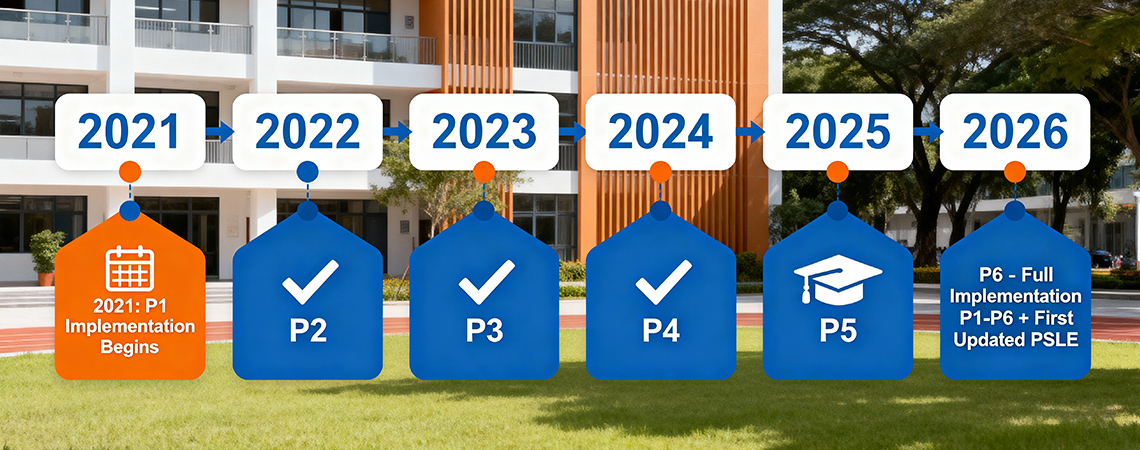
Timeline: From 2021 Introduction to 2026 Full Implementation
The Ministry of Education introduced the updated Primary Mathematics syllabus in 2021, starting with the Primary 1 cohort. This new curriculum has been progressively rolled out level-by-level to ensure smooth transition, with full implementation reaching all levels in 2026.
| Year | Implementation Status |
| 2021 | Started with Primary 1 cohort |
| 2022-2024 | Progressively implemented for P2, P3, and P4 |
| 2025 | Primary 1 to Primary 5 using updated syllabus; Primary 6 still on 2013 syllabus |
| 2026 | Full implementation across all levels (P1 to P6) |
2026: A Milestone Year
- All Primary levels will use the updated Mathematics syllabus
- PSLE 2026 will be the first examination to fully reflect the updated curriculum
- Primary 6 students will no longer be tested on speed, as it has moved to Secondary 1
Official MOE Resource:
Primary Mathematics Syllabus (Updated Dec 2024)
Changes to MOE Primary School Math Syllabus
The Ministry of Education began implementing syllabus changes in 2021, starting with Primary 1. These changes have progressively rolled out across levels, with Primary 1 to Primary 5 already adapted to the new curriculum.
Summary of Changes for Primary 1 to Primary 5 (2021-2025)
For parents with children in Primary 1 to Primary 5, here’s what has already changed in the syllabus:
| Level | What Changed | Impact |
| Primary 1 | • Time concepts introduced (previously P2) • Telling time to 5 minutes • Understanding ‘am’ and ‘pm’ |
Students learn time earlier to develop essential life skills sooner |
| Primary 2 | • Time basics moved to P1 • Greater focus on number operations and fractions |
More time to build strong foundations in core topics |
| Primary 3 | • 12-hour and 24-hour clock added (previously P4) • Bar graphs introduced • Multiplication tables for 6, 7, 8, 9 |
Better spacing of time concepts across lower primary |
| Primary 4 | • Removed: Turns and 8-Point Compass • Removed: Time (12h/24h) moved to P3 • Added: Pie Charts (previously P6) • Added: Nets (previously P6) |
Early exposure to data representation and spatial visualisation prepares students for P5 volume work |
| Primary 5 | • Removed: Average (moved to P6) • Removed: Ratio (moved to P6) • More focus on percentages, volume, geometry • Rate concepts introduced |
Less content load in P5; deeper focus allowed on complex topics like percentages and volume |
Key Takeaway: These changes created a more balanced learning progression, with topics introduced when students are developmentally ready and reduced cognitive load in critical years.
2026: The Game-Changing Year for Primary 6 PSLE
2026 marks a watershed moment in Singapore’s primary mathematics education. For the first time, Primary 6 students will sit for PSLE under the fully updated syllabus. This isn’t just another cohort—it’s the first generation to experience a fundamentally different Primary 6 mathematics curriculum and examination.
Major Changes Affecting Primary 6 Students in 2026
Here’s what Primary 6 students in 2026 need to know about their syllabus:
| What’s Different in P6 (2026) | 2013 Syllabus (Before) | 2021 Syllabus (2026 P6) |
| Speed | ✓ Taught and tested in PSLE | ✗ Removed – Moved to Secondary 1 |
| Average | Taught in P5, revised in P6 | ✓ Taught fresh in P6 (moved from P5) |
| Ratio | Taught in P5, revised in P6 | ✓ Taught fresh in P6 (moved from P5) |
| Basic Algebra | Not taught | ✓ Newly introduced in P6 |
| Pie Charts | Taught in P6 | Already learned in P4 |
| Nets | Taught in P6 | Already learned in P4 |
1. Speed Removed from PSLE
This is the most significant change for P6 students. Speed, known for being one of the most challenging topics, is no longer part of the primary syllabus.
What This Means:
- No speed questions in PSLE 2026 onwards
- More time to master other crucial topics
- Reduced stress during PSLE preparation
- Students learn speed in Secondary 1 after mastering algebra basics
Why It Matters:
Speed questions often required abstract thinking and algebraic reasoning that many primary students found difficult. By moving it to secondary level, students approach the topic when developmentally ready.
2. Average Now Taught in Primary 6
Average has moved from P5 to P6, changing the learning progression for upper primary students.
What Students Need to Know:
- Understanding average as ‘total value ÷ number of data’
- Finding missing values when average is given
- Relationship between average, total value, and number of data
- Solving word problems involving average
Why This Benefits Students:
By P6, students have stronger mathematical maturity to grasp the concept of average. They can handle more complex problems involving this topic alongside their PSLE preparation.
3. Ratio Now Taught in Primary 6
Ratio, another complex topic, has shifted from P5 to P6.
What Students Need to Master:
- Understanding ratio notation (a:b and a:b:c)
- Finding equivalent ratios
- Dividing quantities in given ratios
- Expressing ratios in simplest form
- Relationship between fractions and ratios
Why This Matters:
Ratio requires strong multiplicative reasoning and proportional thinking. P6 students, with more developed mathematical thinking, can better understand and apply ratio concepts.
4. Basic Algebra Introduced
For the first time, P6 students learn basic algebra, giving them a head start for Secondary 1.
What’s Covered:
- Using letters to represent unknown numbers
- Simple algebraic expressions (e.g., x + 3, 2y)
- Evaluating expressions by substitution
- Simple linear equations with whole number coefficients
Why This Is Important:
Introducing algebra in P6 creates a bridge to secondary mathematics. Students enter Secondary 1 with foundational algebraic thinking, making the transition less daunting.
Preparing for 2026 PSLE?
With these significant changes to the Primary 6 curriculum, specialized support can make a crucial difference. Our Primary 6 Math tuition programme is specifically designed to help students master ratio, average, and algebra while preparing for the 2026 PSLE under the new syllabus.
How Parents Can Support Their Child
- Stay updated: Check MOE updates regularly and review school communications to understand which topics your child is learning.
- Act promptly on gaps: With topics introduced earlier, timely intervention is crucial. If your child struggles with a concept, address it before gaps widen.
- Build understanding, not memorisation: Encourage your child to explain their thinking process. Use real-life examples to make abstract concepts relatable.
- Practice regularly: Work through exercises aligned with the current syllabus. Focus on understanding different question types rather than memorising solutions.
- Keep dialogue open: Talk regularly with teachers to monitor progress. Seek clarification on difficult topics early for effective remediation.
- Consider professional support: Quality primary math tuition provides individualised attention to master challenging topics in the updated syllabus.
Professional Support with Daniel’s Math Tuition
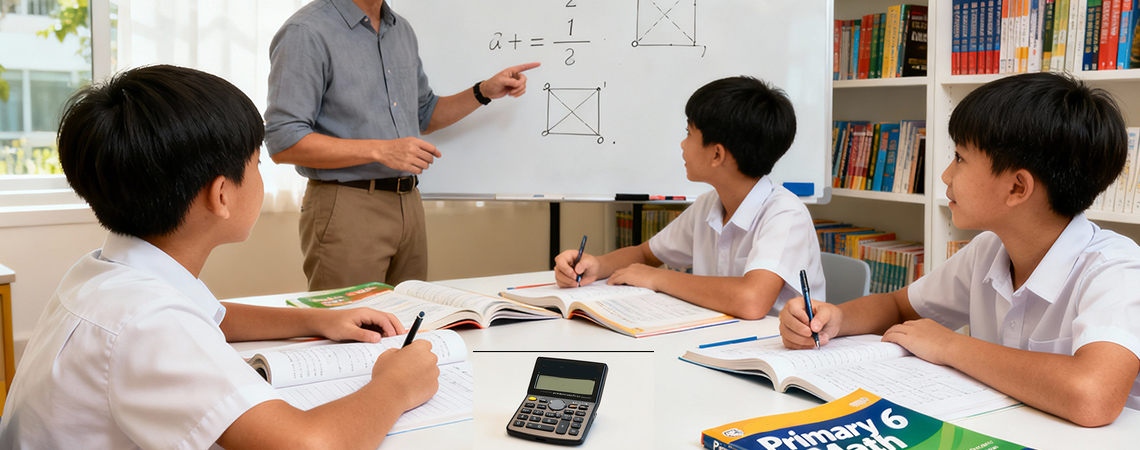
At Daniel’s Math Tuition, our curriculum is fully aligned with the latest syllabus changes to ensure students stay ahead. Here’s how we support your child’s learning journey:
- Experienced MOE-trained educators: Our tutors, including former MOE teachers with over 10 years of teaching experience, understand the updated 2026 syllabus intimately and know exactly how to teach new concepts effectively.
- Small group tuition for personalised attention: We maintain small class sizes to ensure every student receives individualised support, particularly important with accelerated concept introduction.
- 2026-aligned curriculum and resources: Students gain access to updated worksheets and practice papers reflecting all syllabus changes, covering new topics at each level.
- 24/7 WhatsApp support: Students can ask questions anytime, preventing small doubts from becoming major obstacles.
With our proven track record reflected in our 5.0 Google rating, we’ve helped countless students build confidence and achieve excellence. Discover how our primary math tuition programme can support your child’s learning journey.
Final Thoughts
In 2026, all primary levels will be using the updated Mathematics syllabus, marking the completion of a significant curriculum transition. This is particularly important for Primary 6 students who will be the first cohort to sit for PSLE under the fully updated curriculum.
The syllabus restructuring represents a thoughtful approach to mathematics education, emphasising logical progression and age-appropriate learning. By understanding what your child needs to take note of at their current level, you can better prepare them for success.
Stay informed, remain proactive, and seek help when needed. Your involvement makes all the difference in your child’s academic journey.
If you’d like guidance navigating the new syllabus, feel free to contact us. We’ll be happy to advise based on your child’s level.